How much power does an air conditioner use per day in Puerto Rico?
Worked out with the same engine as the simulator · 2026-09-11
There is no single number, and anyone who gives you one is giving you the wrong one. The same 12,000 BTU unit uses 4 kWh a day at night at 79 °F and 17.71 kWh running around the clock at 72 °F — 4.4 times more. The hours and the thermostat are the whole answer.
By size and by schedule, at 75 °F
kWh per day. The hours under each column are the ones the simulator uses for that schedule.
| Size | All day 24 h | Daytime 12 h | Afternoon and night 10 h | At night only 9 h |
|---|---|---|---|---|
| 9.000 BTU 0.45 kW running · 0.9 kW peak |
10.8 | 5.4 | 4.5 | 4.05 |
| 12.000 BTU 0.6 kW running · 1.2 kW peak |
14.4 | 7.2 | 6 | 5.4 |
| 18.000 BTU 0.95 kW running · 1.9 kW peak |
22.8 | 11.4 | 9.5 | 8.55 |
| 24.000 BTU 1.25 kW running · 2.4 kW peak |
30 | 15 | 12.5 | 11.25 |
| 36.000 BTU 1.85 kW running · 3.4 kW peak |
44.4 | 22.2 | 18.5 | 16.65 |
These are not nameplate figures: the kW is the average draw of an inverter mini-split already holding temperature, so the cycling is already in the number. A clear day is the reference. On a rainy day the same 12,000 BTU unit at night drops to 3.29 kWh instead of 5.4 — cooler outside, and an inverter modulates lower.
The thermostat, on the same unit
Running at night only. Every degree you give back is the one free lever there is.
| Size | 72 °F | 75 °F | 77 °F | 79 °F |
|---|---|---|---|---|
| 9.000 BTU | 4.98 | 4.05 | 3.48 | 3 |
| 12.000 BTU | 6.64 | 5.4 | 4.64 | 4 |
| 18.000 BTU | 10.52 | 8.55 | 7.35 | 6.33 |
| 24.000 BTU | 13.84 | 11.25 | 9.67 | 8.32 |
| 36.000 BTU | 20.48 | 16.65 | 14.32 | 12.32 |
What this means for panels and battery
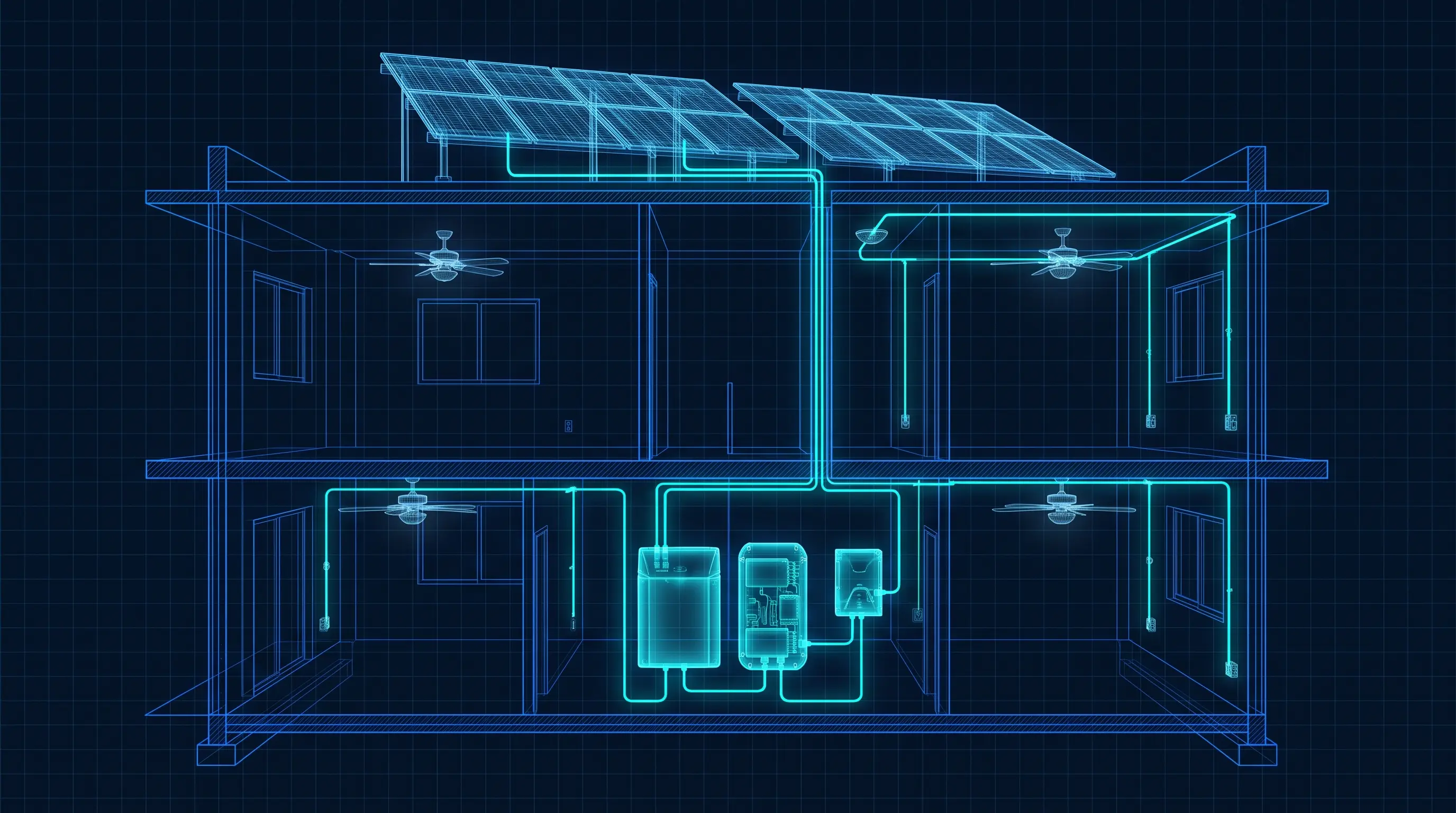
A 5.4 kWh a day A/C is roughly what three or four panels harvest on a good day in Puerto Rico. A 18.5 kWh living-room unit is more than a whole small house. And at night none of it comes from the sun: it comes out of the battery, which is why the A/C schedule decides how many days you last with no grid far more than the panel count does.
Work out your own system, hour by hour →
Free, no card and no sign-up. Every A/C with its own schedule and thermostat, your town's sun, and how many days it lasts with no grid.
The kW column is the average draw of an inverter mini-split already holding temperature — 0.45 to 0.8 kWh per hour per ton in cooling, from field measurements — plus the starting draw, which on an inverter is far lower than on a conventional unit. The daily totals come from running the same hour-by-hour engine as the simulator with that one unit on and everything else off. Your unit will differ with its age, its efficiency, the insulation and how much sun the room gets: treat these as the shape of the answer, not as a reading off your meter.