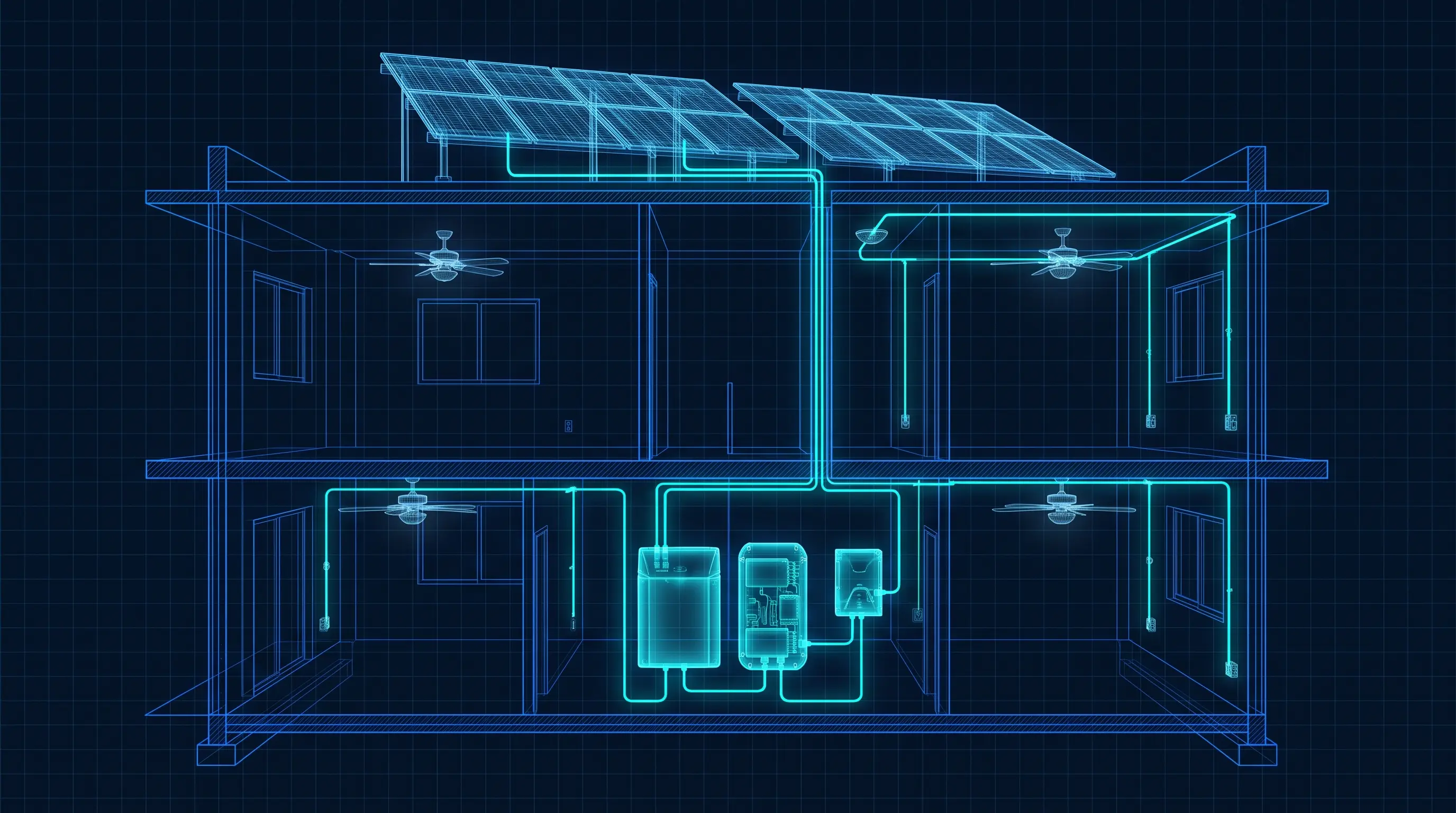
How many days does a solar system last with no grid in Puerto Rico?
Run day by day with the same engine as the simulator · 2026-09-11
Everyone sells you what you save in a year. After a hurricane the question is a different one, and a yearly average cannot answer it: it takes the twenty-four hours of a bad day, one after another, until the battery cannot carry the night. That is what these tables are — overcast days back to back, no generator, and the grid down.
Days it lasts, by battery and panels
Read it as the number of full days before the lights go out during the night. 14+ means the count stops there, not that the system gives up.
The essentials
Lights, outlets and the fridge. No A/C.
| Battery | 6 panels 3.51 kW | 10 panels 5.85 kW | 14 panels 8.19 kW | 18 panels 10.53 kW |
|---|---|---|---|---|
| 16.0 kWh | 4 | 14+ | 14+ | 14+ |
| 32.0 kWh | 10 | 14+ | 14+ | 14+ |
| 48.0 kWh | 14+ | 14+ | 14+ | 14+ |
With one A/C at night
The essentials plus one 12,000 BTU bedroom unit, 9pm to 6am.
| Battery | 6 panels 3.51 kW | 10 panels 5.85 kW | 14 panels 8.19 kW | 18 panels 10.53 kW |
|---|---|---|---|---|
| 16.0 kWh | 1 | 2 | 14+ | 14+ |
| 32.0 kWh | 2 | 6 | 14+ | 14+ |
| 48.0 kWh | 3 | 10 | 14+ | 14+ |
How people actually live
The essentials, a 36,000 BTU living-room unit from 1pm to 11pm, a 12,000 BTU bedroom unit at night, and a freezer.
| Battery | 6 panels 3.51 kW | 10 panels 5.85 kW | 14 panels 8.19 kW | 18 panels 10.53 kW |
|---|---|---|---|---|
| 16.0 kWh | 0 | 0 | 0 | 0 |
| 32.0 kWh | 0 | 0 | 0 | 0 |
| 48.0 kWh | 0 | 0 | 1 | 1 |
Why the third table is full of zeros
It is not a bug, and it was the finding of writing this page. The house as people actually live in it goes dark during the first night in eleven of the twelve combinations — including 48 kWh of battery with 18 panels. One appliance does all of it: the 36,000 BTU living-room unit.
Same system in all three rows — 14 panels and 32.0 kWh:
| The living-room unit | Days with no grid |
|---|---|
| On 1pm to 11pm | 0 |
| On 7am to 7pm — off at night | 0 |
| Off. Only the bedroom unit | 8 |
Moving it to daytime hours barely helps: on an overcast day the panels do not come close to the 15 kWh it eats, so it drains the battery in daylight too. Turning it off is what changes the answer, and it changes it completely.
That is the honest version of what a solar system buys you in a blackout. Nobody sells it that way, and it is the thing worth knowing before you spend: the equipment decides how long you last at a given consumption, and the living-room A/C moves that consumption more than any battery you can reasonably buy.
More battery or more panels?
With one A/C at night, 10 panels and 16 kWh you get 2 days. Doubling the battery takes it to 6; adding four panels instead takes it to 14+. On this house the panels wins — and it is not the same answer at both ends of the table, which is why «it depends» without the number is worth nothing.
The reason is that on an overcast day the panels harvest a fraction of what they would on a clear one, so past a point the extra panel has nothing to give and the night is decided by what is stored. That crossover moves with your consumption, your roof and your town.
Work out your own, hour by hour →
Free, no card and no sign-up. Your appliances one by one, your town's sun, and the day it stops closing.
Worked out with a 0.585 kW panel and a 12 kW hybrid inverter, in the mountain region — the weakest sun on the island, so the safe side of the question. A day is counted as lasting when there is no hour without power. The battery keeps a 20 % floor, which is what real systems are configured with and what the warranty cycle counts assume. Your own number will differ with your consumption, your roof and your equipment: this is the shape of the answer, not a promise.